
Radio Frequency Identification, or RFID, is one of those technologies that most people interact with daily without giving it a second thought. Tapping a contactless bank card, scanning an access badge at the office, or even tracking a parcel through a warehouse – all of these rely on RFID. But what actually happens in that split-second exchange between a tag and a reader? How does a tiny chip with no battery manage to communicate data wirelessly? This article pulls back the curtain on the physics, the hardware, and the different flavours of RFID that make modern automatic identification possible.
The Core Principle: Electromagnetic Coupling and Backscatter
At its heart, RFID is built on a simple principle from physics: electromagnetic induction and, at higher frequencies, radiative coupling. If you have ever used a wireless phone charger, you already have an intuition for how passive RFID works. A wireless charger uses a coil to generate an alternating magnetic field, and a receiving coil in your phone converts that field back into electrical current. RFID uses the same underlying mechanism, but instead of just transferring power, the tag also modulates the signal to send data back to the reader.
In a passive RFID system, the reader transmits a carrier signal from its antenna. When this signal reaches a passive tag, the tag’s antenna absorbs enough energy from the electromagnetic field to power up its integrated circuit. The chip then modulates the impedance of its antenna, which alters the reflected signal in a process known as backscatter. The reader detects these tiny variations in the reflected signal and decodes them into meaningful data. There is no battery on the tag. The entire transaction is powered by the reader’s transmitted energy field.
This is where the parallel with wireless charging becomes particularly clear. Both technologies rely on resonant coupling between two antennas tuned to the same frequency. The difference is purpose: wireless charging maximises power transfer efficiency, while RFID optimises for data communication with just enough harvested energy to wake the chip.
Active vs Passive RFID: Two Fundamentally Different Approaches
RFID splits into two broad categories based on how the tag gets its power: active and passive. Understanding the distinction is essential because it determines read range, cost, battery life, and suitable applications.
Passive RFID tags contain no onboard power source. As described above, they harvest energy from the reader’s RF field, use it to power their IC, and respond via backscatter modulation. Because they rely entirely on the reader for power, their read range is limited by how much energy the reader can deliver to the tag. Passive tags are cheap to manufacture, often costing just a few pence each in volume, and they have an effectively unlimited operational lifespan since there is no battery to deplete. This makes them ideal for high-volume applications such as retail inventory, supply chain tracking, and access control.
Active RFID tags, by contrast, carry their own battery. This onboard power source means the tag can transmit its own signal rather than relying on backscatter. The result is significantly greater read range, often 100 metres or more compared to a few metres for most passive systems. Active tags can also support more complex sensors, larger memory, and continuous broadcasting (known as beaconing). The trade-off is cost and maintenance. Active tags are more expensive, physically larger, and their batteries eventually need replacing, typically after three to five years depending on beacon rate and environmental conditions.
There is also a middle ground: Battery-Assisted Passive (BAP) tags, sometimes called semi-passive tags. These contain a battery that powers the IC, but they still communicate via backscatter rather than active transmission. This gives them better read range and sensitivity than purely passive tags while keeping the communication method simple.
Frequency Bands: LF, HF, and UHF
RFID operates across several frequency bands, and the choice of frequency has a profound impact on read range, data rate, penetration through materials, and susceptibility to interference. The three primary bands are Low Frequency (LF), High Frequency (HF), and Ultra-High Frequency (UHF).
Low Frequency (LF) – 125 kHz to 134.2 kHz
LF RFID uses near-field inductive coupling. The tag and reader antennas behave like the primary and secondary windings of a transformer, with energy transferred through the magnetic component of the electromagnetic field. Because the wavelength at 125 kHz is extremely long (approximately 2,400 metres), the tag is always in the near field of the reader antenna, and propagation behaves according to magnetic field coupling rather than wave propagation.
LF signals penetrate water and animal tissue reasonably well, which is why this frequency band has been the standard for animal identification and livestock tagging for decades. It is also widely used in access control and vehicle immobiliser systems. The downside is short read range (typically under 10 cm) and slow data transfer rates. The low carrier frequency simply cannot support high bandwidth.
High Frequency (HF) – 13.56 MHz
HF RFID also operates primarily through inductive coupling, but at a much higher carrier frequency. The wavelength at 13.56 MHz is about 22 metres, so the tag is still typically within the near field of the reader, but the shorter wavelength allows for smaller, more efficient antennas and higher data transfer rates than LF.
The 13.56 MHz band is globally allocated for industrial, scientific, and medical (ISM) use, making it one of the most universally available RFID frequencies. It forms the basis for several important standards, including ISO 15693 for vicinity cards and ISO 14443 for proximity cards.
NFC: The HF Subset Everyone Knows
Near Field Communication, or NFC, operates at 13.56 MHz and is technically a subset of HF RFID. What distinguishes NFC is its standardised communication protocols (defined in the NFC Forum specifications and built on ISO 14443 and FeliCa) and its support for peer-to-peer communication. While traditional HF RFID is strictly a reader-to-tag relationship, NFC devices can operate in three modes: reader/writer mode, card emulation mode, and peer-to-peer mode.
This flexibility is what makes NFC so versatile. Your smartphone can read an NFC tag (reader/writer mode), emulate a contactless payment card (card emulation mode), or exchange data with another NFC device (peer-to-peer mode). The intentionally short read range of NFC, typically 4 cm or less, is a feature rather than a limitation. It provides an implicit layer of security since you must physically bring the two devices close together to establish communication.
Ultra-High Frequency (UHF) – 860 MHz to 960 MHz
UHF RFID represents a fundamentally different approach to the RF link. At these frequencies, the wavelength is approximately 33 cm, meaning the tag is typically in the far field of the reader antenna. Communication relies on radiative coupling and backscatter rather than inductive coupling. The reader transmits a continuous wave, and the tag modulates its radar cross-section by switching its antenna between matched and mismatched impedance states. The reader then detects these amplitude or phase changes in the reflected signal.
This far-field operation is what gives UHF RFID its impressive read ranges, commonly 5 to 12 metres with standard passive tags and commercial readers. Data rates are also substantially higher than LF or HF, enabling rapid inventory of hundreds of tags per second. The RAIN RFID alliance, which promotes the GS1 UHF Gen2 standard (ISO 18000-63), has driven massive adoption of UHF RFID in retail, logistics, healthcare, and manufacturing.
However, UHF has its challenges. Water absorbs UHF energy and metals reflect it, causing multipath interference and detuning of tag antennas. Significant engineering goes into designing UHF tags that perform reliably on or near metal and liquid surfaces, using techniques such as raised antenna designs, spacer layers, and impedance-matching strategies.
The specific frequency allocation within the UHF band varies by region. In Europe, ETSI regulations permit operation between 865.6 MHz and 867.6 MHz, while the FCC in the United States allows 902 to 928 MHz. This regional variation must be accounted for when deploying global RFID systems.
Inside an RFID Reader: Antenna, Decoder, and Controller
An RFID reader is more than just an antenna. It is a carefully engineered system comprising several key components working together.
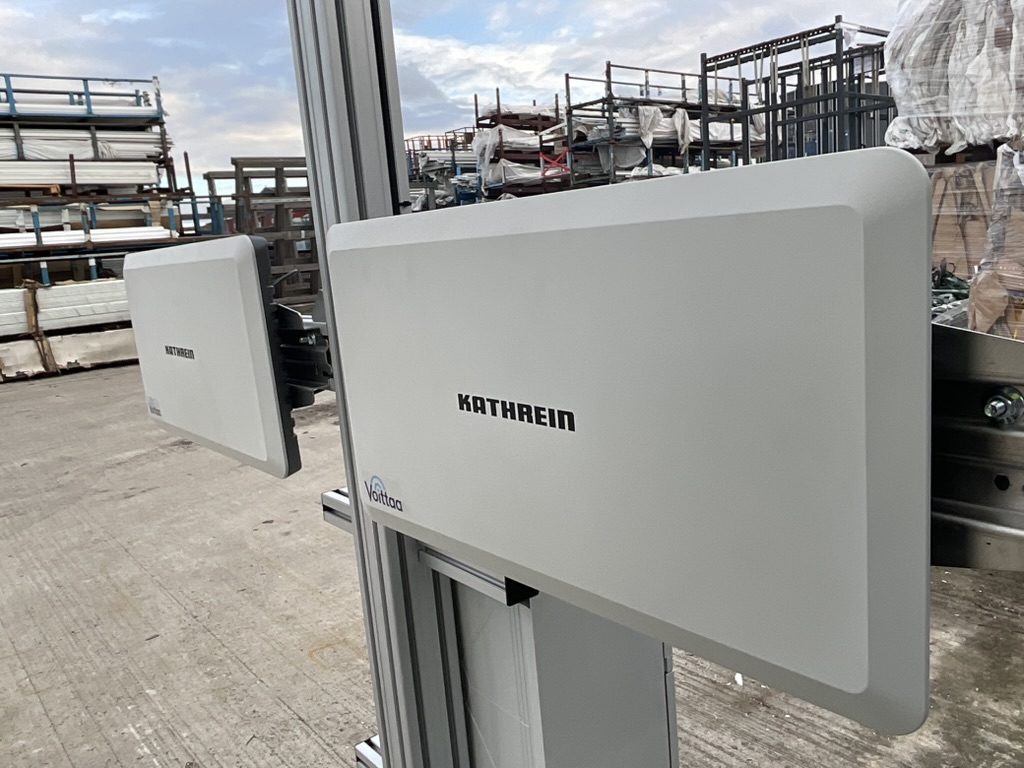
The antenna is the most visible part. In UHF systems, this is typically a circularly polarised patch antenna designed to maintain consistent read performance regardless of tag orientation. In HF and LF systems, the antenna is usually a coil or loop antenna optimised for magnetic coupling. Reader antennas come in various form factors, from handheld devices to fixed portal readers used in warehouse dock doors.
Behind the antenna sits the RF front end, which handles signal generation, amplification, and reception. The transmitter generates the carrier signal at the required frequency and power level, while the receiver must detect the extremely weak backscatter signal from the tag. The difference in power between the transmitted signal and the received backscatter can be 60 dB or more, making receiver sensitivity and noise floor critical design parameters.
The decoder, or baseband processor, extracts the data from the demodulated backscatter signal. It handles the protocol-specific encoding schemes. For example, UHF Gen2 uses a combination of PIE (Pulse Interval Encoding) for the reader-to-tag link and FM0 or Miller encoding for the tag-to-reader link. The decoder must also manage the anti-collision algorithms that allow a single reader to communicate with multiple tags simultaneously without data collisions.
Finally, the controller manages the overall reader operation, handles communication with host systems (via Ethernet, USB, serial, or wireless interfaces), and implements the higher-level application logic. In modern readers, this is often a capable embedded processor running a real-time operating system.
The Physics of Energy Harvesting
One of the most remarkable aspects of passive RFID is the tag’s ability to harvest enough energy from the reader’s field to power a silicon integrated circuit. At UHF frequencies, a typical passive tag IC requires between 15 and 30 microwatts to operate. The tag antenna must capture this power from the incident RF field while simultaneously modulating the backscatter signal for data transmission.
The tag IC contains a charge pump rectifier circuit that converts the received AC signal into DC voltage to power the chip’s digital logic. As reader-to-tag distance increases, the available power drops according to the inverse square law in the far field (for UHF) or the inverse cube law in the near field (for LF and HF). This power budget is ultimately what limits the read range of passive RFID systems.
Advances in IC fabrication technology have steadily reduced the power requirements of RFID chips, which directly translates into improved read range and reliability. Modern UHF RFID ICs from manufacturers like Impinj, NXP, and EM Microelectronic achieve sensitivity levels below -22 dBm, a figure that seemed unreachable a decade ago.
Bringing It All Together
RFID is not a single technology but a family of technologies united by a common principle: using radio frequency electromagnetic fields to identify and track objects without physical contact or line of sight. Whether it is an LF tag embedded in a cow’s ear, an NFC chip in a smartphone enabling a contactless payment, or a UHF label on a pallet racing through a distribution centre, the underlying physics of electromagnetic coupling, energy harvesting, and backscatter modulation remain consistent.
Understanding these fundamentals is what separates those who deploy RFID effectively from those who treat it as a black box. The choice of frequency band, active versus passive architecture, antenna design, and reader configuration all flow from the physics. Get those foundations right, and RFID delivers the kind of reliable, scalable automatic identification that drives modern supply chains, security systems, and connected products.