
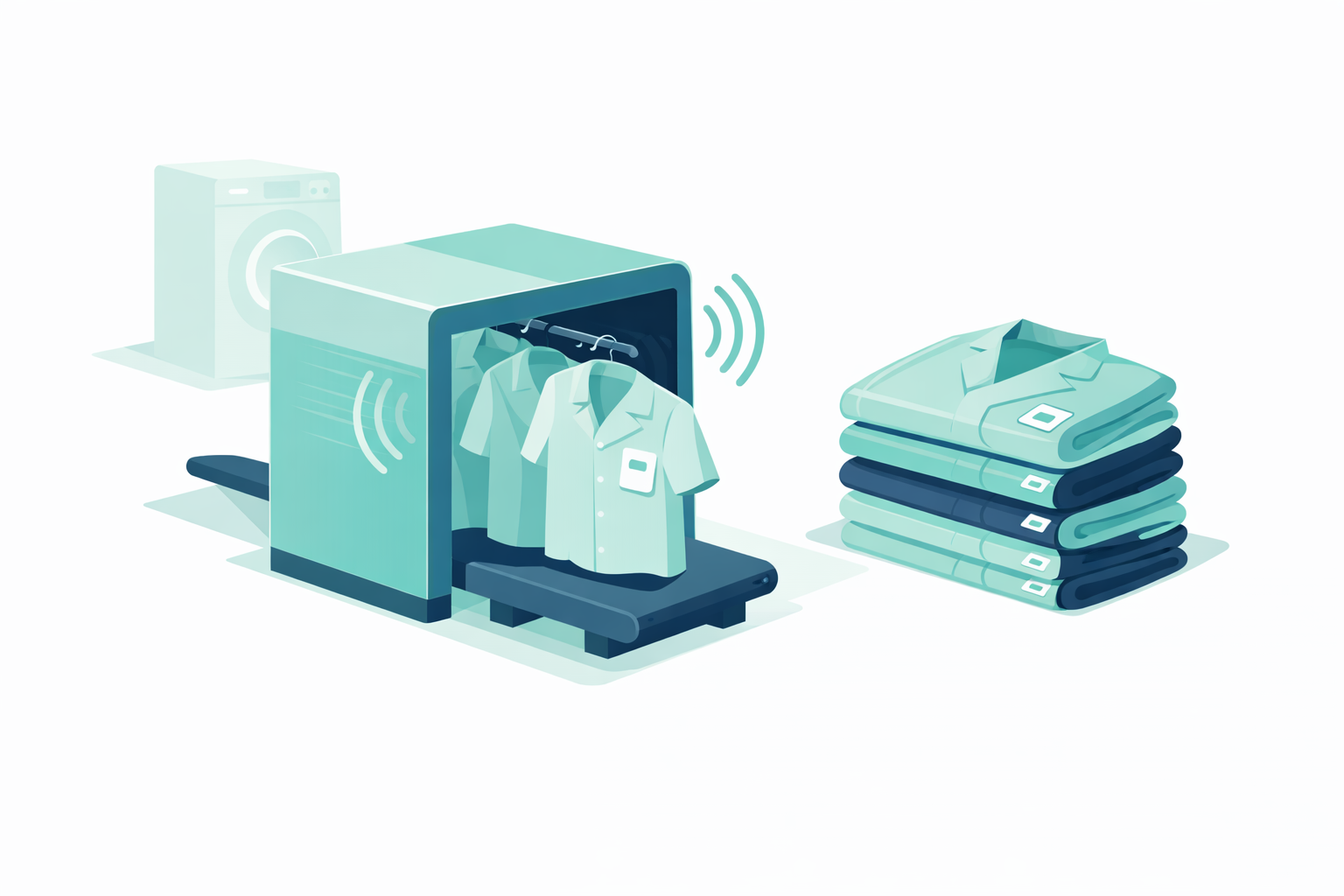
Commercial laundry operations handle thousands of garments every day. Hospitals, hotels, uniform rental companies and industrial linen services all face the same challenge: keeping track of what goes out, what comes back and what has gone missing. RFID technology solves this problem by giving every garment a permanent digital identity that can be read automatically at every stage of the workflow.
How Garments Get Tagged
It starts with the tag itself. UHF laundry tags are purpose-built for the punishment of an industrial wash cycle. Encapsulated in heat-resistant, chemical-resistant housings, these tags survive repeated exposure to temperatures above 60 degrees Celsius, harsh detergents and high-speed tumble drying. Most are sewn into seams or heat-sealed onto fabric, making them virtually invisible to the wearer. Each tag carries a unique EPC (Electronic Product Code) that links to a database record containing garment type, owner, size, wash history and current status.
The End-to-End Workflow
When soiled garments arrive at a laundry facility, they pass through a UHF tunnel reader at the collection point. This reader captures every tag in the batch within seconds, even when items are bundled together in bags. There is no need to open, sort or count anything manually. The system instantly logs which garments have been received and flags anything overdue.
From there, garments move to sorting. Automated conveyor systems equipped with RFID readers can divert items by client, garment type or wash programme. This removes the labour-intensive step of hand sorting and dramatically reduces mis-sorts. In high-volume operations, tunnel readers at this stage can process over 1,000 items per hour.
After washing, drying and finishing, garments pass through another read point at dispatch. The system confirms that every item allocated to a particular delivery is present and correct before it leaves the building. If something is missing, the operator gets an immediate alert rather than discovering the shortfall after the truck has gone.
Inventory Reconciliation
RFID makes perpetual inventory a reality rather than an aspiration. Because every movement is captured automatically, operators can reconcile stock in real time. They know exactly how many garments each client has in circulation, how many washes each item has been through and when replacements are due. This data feeds directly into billing, procurement and contract management systems.
Why It Pays Off
The return on investment from RFID in laundry management comes from several directions at once. Garment loss typically drops by 15 to 25 percent in the first year, simply because every item is accounted for and discrepancies are caught immediately. Labour savings are equally significant. Manual counting and sorting tasks that once occupied entire shifts can be handled by a handful of tunnel readers, freeing staff for higher-value work.
Turnaround times improve because there is no bottleneck at the counting stage. Garments flow through the facility faster, which means clients get their linen back sooner and the operation can handle greater throughput without adding floor space.
Perhaps most importantly, RFID creates accountability. Every touch point is logged, every handover is recorded and every discrepancy has a data trail. Disputes over missing items become straightforward to resolve, and contract negotiations are backed by hard numbers rather than estimates.
For any commercial laundry operation processing more than a few hundred items a day, UHF RFID is no longer a nice-to-have. It is the operational backbone that makes efficiency, accuracy and profitability achievable at scale.