
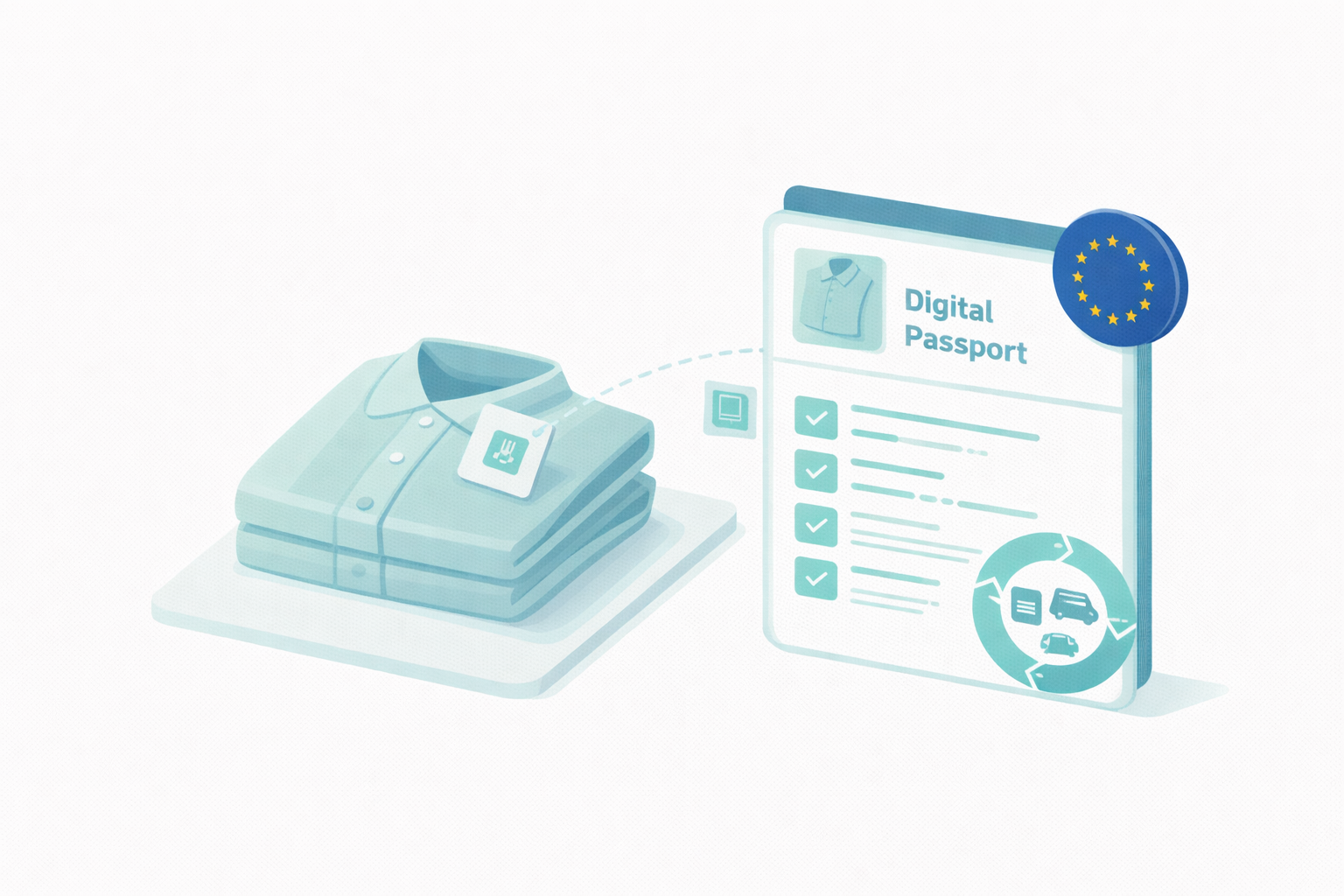
The European Union’s Digital Product Passport (DPP) initiative is set to reshape how manufacturers, retailers, and consumers interact with product data. At the heart of this transformation sits RFID technology, positioned as the most practical and scalable method for linking physical products to their digital identities.
What Is a Digital Product Passport?
A Digital Product Passport is a structured digital record that travels with a product throughout its lifecycle. It contains information about a product’s origin, materials, manufacturing processes, repairability, and end-of-life recycling instructions. The EU introduced the DPP framework under the Ecodesign for Sustainable Products Regulation (ESPR), adopted in 2024, with the goal of driving circular economy practices and giving consumers transparent access to sustainability data.
The regulation targets specific product categories in phases. Batteries were first, with requirements already taking shape. Textiles and electronics follow closely, with broader rollouts expected through 2027 and beyond. By the end of the decade, most products sold within the EU market will need a DPP.
Why RFID Is the Natural Fit
While QR codes and other optical identifiers have their place, RFID offers distinct advantages that make it the preferred carrier technology for DPP data links.
UHF RFID, particularly RAIN RFID based on the ISO 18000-63 standard, enables bulk reading of tagged items without line-of-sight. A warehouse receiving hundreds of palletised goods can verify DPP compliance in seconds rather than scanning individual codes one at a time. For manufacturers dealing with high-volume production lines, this speed is not optional. It is essential.
NFC, operating at 13.56 MHz under ISO 14443 and ISO 15693, adds a consumer-facing layer. Shoppers can tap an NFC-enabled product with their smartphone to instantly access the DPP record, viewing details about where a garment was made, what chemicals were used, or how to recycle the packaging. This tap-to-read simplicity closes the gap between regulation and real-world usability.
Dual-frequency inlays combining UHF and NFC on a single tag are gaining traction for exactly this reason. They serve the supply chain’s need for speed and the consumer’s need for convenience in one integrated solution.
What Manufacturers Need to Prepare
Compliance with the DPP regulation is not a switch that flips overnight. Manufacturers should begin preparing now across several fronts.
First, data infrastructure needs attention. A DPP requires accurate, structured data about every product. Companies that lack robust product lifecycle management (PLM) systems will need to invest in capturing and organising this information.
Second, tagging strategy matters. Selecting the right RFID inlay, whether UHF, NFC, or dual-frequency, depends on the product type, packaging constraints, and where in the supply chain the tag will be read. Embedding RFID into garment labels differs significantly from tagging battery modules or electronic components.
Third, serialisation is critical. Each product needs a unique identifier linked to its DPP record. GS1 standards, including the SGTIN and GIAI schemes, provide the framework for this, and many RAIN RFID deployments already support GS1 EPC encoding natively.
A Practical Compliance Roadmap
For companies looking to get ahead of the curve, a phased approach makes sense.
In 2025 and 2026, focus on auditing existing product data and identifying gaps. Engage with your RFID tag suppliers and solution providers to evaluate tagging options. Run pilot programmes on a single product line to test data capture, tag performance, and system integration.
Through 2027, scale tagging across priority product categories. Integrate DPP data flows with existing ERP and supply chain management platforms. Ensure your serialisation processes align with GS1 standards.
From 2028 onward, expand to full product coverage as regulatory deadlines arrive for additional categories. Monitor evolving EU guidance and adjust your approach as standards mature.
The DPP regulation is not just a compliance burden. It is an opportunity to build trust with consumers, improve supply chain visibility, and future-proof operations. RFID technology, proven across billions of tagged items worldwide, provides the foundation to make it work at scale.