
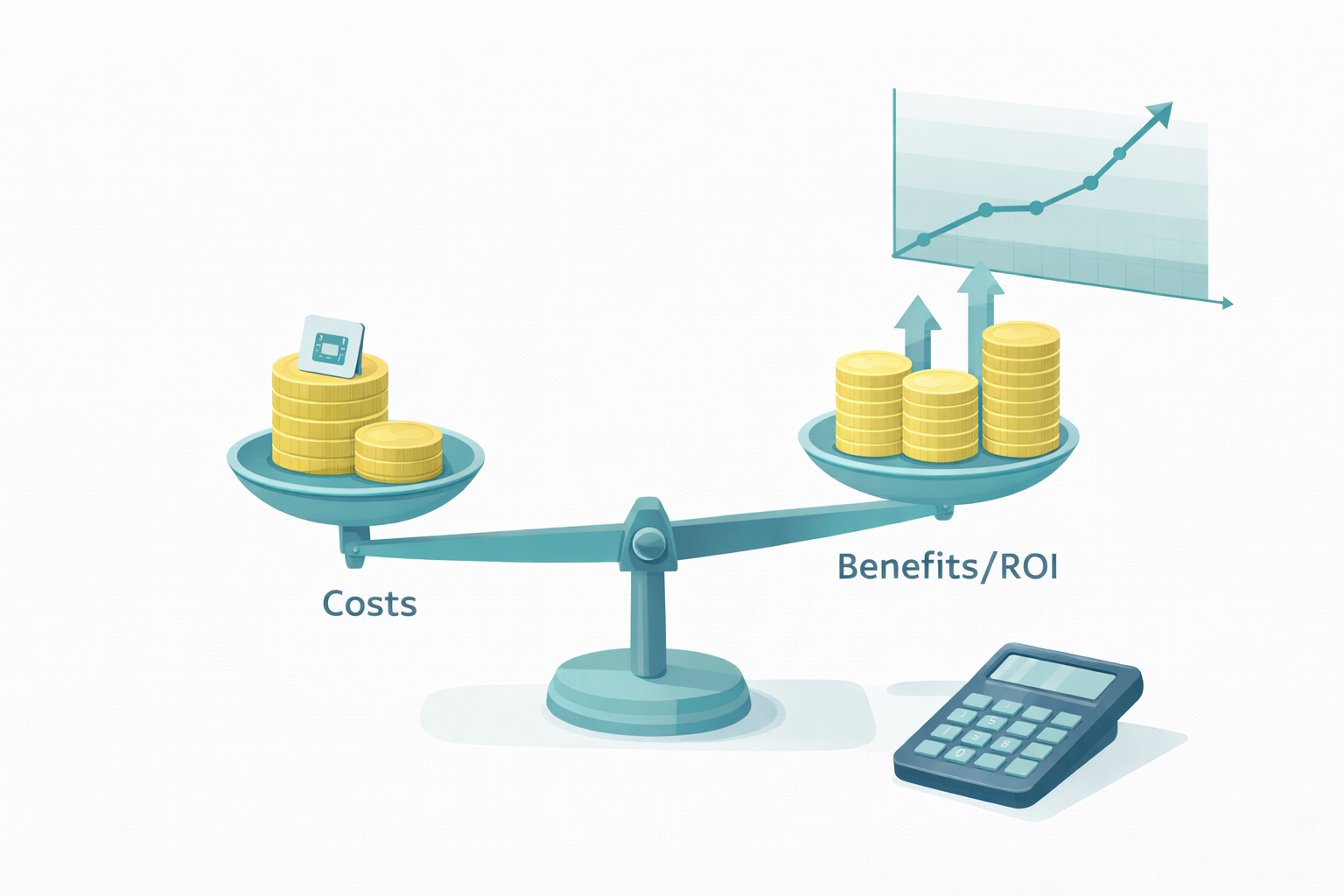
Every RFID deployment starts with a simple question: will this pay for itself? Whether you are pitching to a CFO, a board, or your own operations team, a well-structured business case turns speculation into confidence. Here is a practical framework for modelling the return on investment of an RFID rollout and getting the green light.
Map Out the Full Cost Picture
The biggest mistake in RFID budgeting is focusing solely on tag prices. Tags are just one line item. A complete cost model should cover five categories:
Tags and consumables. Unit costs vary widely. A passive UHF inlay for retail might sit below five pence, while a ruggedised on-metal tag for asset tracking could reach several pounds. Multiply by expected volume and factor in attrition rates for tags that get damaged or lost.
Readers and antennas. Fixed readers at dock doors, handheld readers for cycle counts, overhead readers for conveyor lines. Include mounting hardware, cabling, and any edge-computing devices needed at the read point.
Middleware and software. This is the layer that filters, deduplicates, and routes tag data into your existing systems. Some organisations use commercial RFID middleware platforms; others build lightweight connectors directly into their ERP or WMS. Either way, licence fees, hosting, and ongoing support belong in the model.
Integration. Connecting RFID event data to warehouse management, ERP, or point-of-sale systems is often the most underestimated cost. Budget for API development, data mapping, user acceptance testing, and a parallel-run period where old and new processes overlap.
Training and change management. Staff need to understand new workflows, how to handle exceptions when a tag fails to read, and how to interpret dashboard data. A rushed training phase leads to workarounds that erode ROI.
Quantify the Benefits
Hard savings are the easiest to defend. Calculate current labour hours spent on manual counts, barcode scanning, or searching for misplaced assets, then estimate the reduction RFID will deliver. In retail, inventory accuracy improvements from around 65 percent to above 95 percent are well documented and translate directly into fewer stockouts and markdowns.
Soft benefits matter too, but label them honestly. Faster receiving, improved compliance audit times, and better customer experience all have value. Assign conservative estimates and flag them as secondary gains rather than primary justification.
Calculate the Payback Period
A simple payback model works for most initial business cases. Divide total project cost by annual net benefit to find the number of years until the investment breaks even. Many RFID projects in logistics and retail achieve payback within 12 to 18 months. For asset tracking in healthcare or manufacturing, the timeline may stretch to two years but often comes with regulatory or safety benefits that carry weight beyond pure financials.
For larger deployments, consider a discounted cash flow approach that accounts for phased rollouts and scaling costs. A pilot phase covering one facility or product line keeps upfront risk low while generating real data to refine the model before full-scale commitment.
Present It as a Template
Structure your business case document with an executive summary, a cost breakdown table, a benefits summary with assumptions clearly stated, a payback timeline, and a risk register. Keep the language plain and the numbers auditable. Decision-makers trust a model they can stress-test over one that looks polished but hides its assumptions.
Building a business case for RFID is not about proving the technology works. That debate is long settled. It is about proving it works for your operation, at your scale, with your constraints. Get the cost categories right, quantify benefits conservatively, and let the numbers make the argument.